articles
True Stuff: Socrates vs. The Written Word
7 passages marked
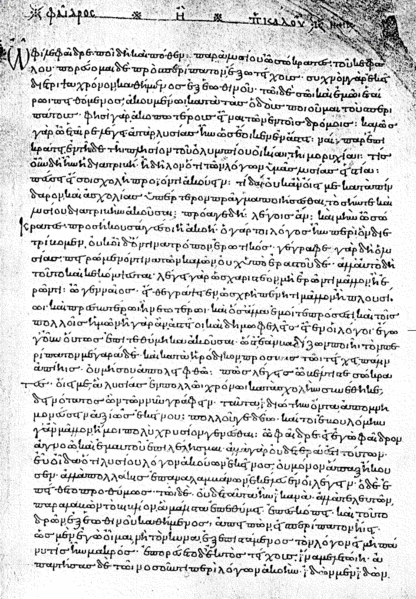
Phaedrus the Egyptian legend of Theuth, the god who invented “numbers and arithmetic and geometry and astronomy, also draughts and dice, and, most important of all, letters.”)
Thamus replied, “Most ingenious Theuth, one man has the ability to beget arts, but the ability to judge of their usefulness or harmfulness to their users belongs to another; and now you, who are the father of letters, have been led by your affection to ascribe to them a power the opposite of that which they really possess.
Socrates lays out an argument that the written word cannot defend itself in dialogue, and thus cannot effectively teach anything worth knowing. For only through banter, through back-and-forth discussion and rhetorical argument and the working out of problems, can true knowledge be conveyed. Reading mere *words,* in his mind, is akin to looking at a lake rather than swimming in it — or worse, looking at a lake and thinking that now you know *how* to swim.)
[Dionysios the Younger](http://en.wikipedia.org/wiki/Dionysius_II_of_Syracuse) of Syracuse, a brutal tyrant, who has written a treatise on philosophy.)
Plato argues that he must have done it for fame or glory, because it’s clearly a scam — philosophy can’t be taught in *writing*; it can only be felt, experienced, argued out and sensed.)
In a way this is an argument very similar to that of Trithemius [against the printing press](http://wondermark.com/true-stuff-monk-vs-press/) — that a perceived *flattening* or *automating* of a form necessarily involves a loss; that truth (whether it be philosophy or Scripture) is best consumed and absorbed *experientially.* I think this is a great sentiment and one worth considering even now.)
the speech-vs-text argument appears again in the 1880s, but in *reverse:* with the advent of the telephone, hands are wrung that communication will become rife with error and misunderstanding because unlike the telegraph, the newfangled telephone leaves no written record!)