articles
How Realistic Is the Movie Interstellar?
13 passages marked
To put this into perspective, traveling **90 miles per hour is equivalent to traveling 132 feet per second.** If we visualize that the speed of light is 982,080,000 feet per second, we can easily see the limit for humanity.)
if we traveled at a thousandth of the speed of light, our speed would still be 186 miles per second or 982,080 miles per hour.)
time is a concept that continuously flows from the past to the future.)
An interesting fact about black holes is that the idea of such things existed in 18th-century scientists. A physicist by the name of John A. Wheeler had this to say about them at the time: **if the mass of a star is big enough, then even light itself cannot escape it.**)
John Wheeler states that **even though light is incredibly fast, its energy is finite and cannot escape the gravity of a big enough star (or black hole).** That is because as a star gains size, its gravity also increases.)
John Wheeler’s theory doesn’t hold up today because it doesn’t match the concept of the speed limit, that nothing in this universe can be faster than light.)
The Schwarzschild radius, or the event horizon, is the point at which light slows down and stops. The radius at which the light stops forms a sphere around the black hole.)
The watch of the astronaut who stayed back works normally, ticking away at whatever speed it normally does. However, the watch on the astronaut going toward the black hole starts to slow down. It ticks increasingly slower until it stops completely, signifying he has reached and passed the event horizon.)
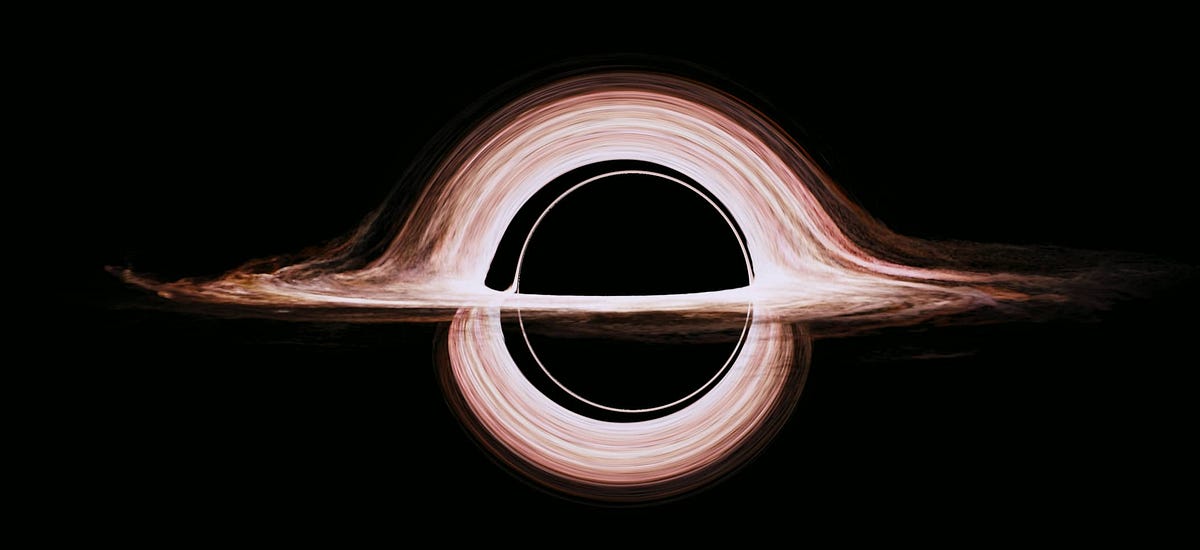
One is the black holes at the center of galaxies, which are massive even for black holes. The other is when there is a rotating star pair, and we can’t see one. We know there must be something the star is rotating around, but we cannot see it, signifying the other star is a black hole. This means that because the star cannot escape the other (now a black hole), it orbits around it, slowly losing mass to it. Eventually, it falls completely. We call this the accretion disk. As the star spirals into the black hole, mass is ripped from it, feeding the black hole and making it larger.)
The issue is that rotating black holes possess both radial and lateral forces.)
There is another solution within Einstein’s works in the 1930s. According to the theory, a black hole is essentially a tube gate, the proper term being a wormhole. **He says you can go through the singularity of a black hole and come out of a white hole.**)
I mentioned above that we think there may be a black hole at the center of our galaxy. This theory was introduced in 1995 by Andrea Ghez after she spent years studying the orbits of our galaxy. Her analysis of our galaxy revealed the theory that a black hole may be at its center.)
We have been conducting experiments to observe gravitational waves since the 1960s to no avail; however, we know they exist because of Hulse and Taylor’s millisecond pulse discovery in 1975.)